

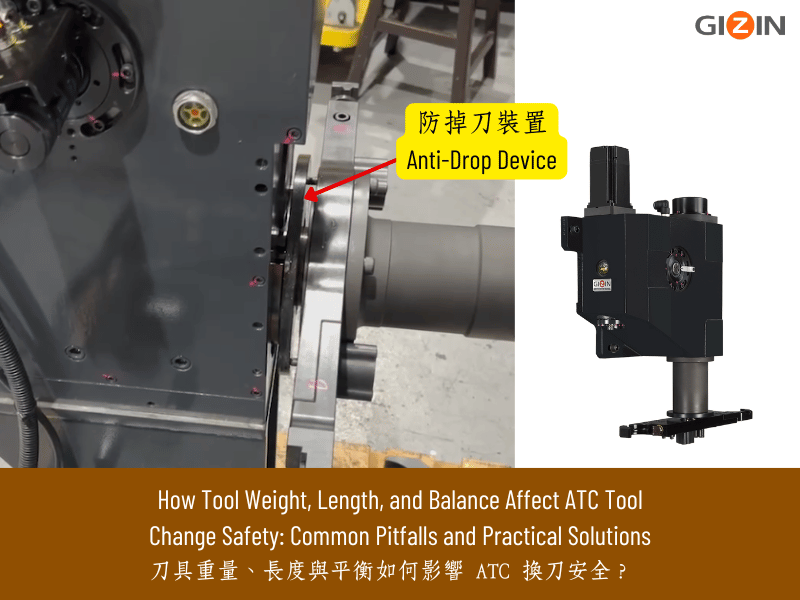
How Tool Weight, Length, and Balance Affect ATC Tool Change Safety: Common Pitfalls and Practical Solutions
In the world of CNC automation, automatic tool changers (ATCs) significantly enhance machining productivity and flexibility. However, many users still encounter a recurring issue: tool drop or spindle damage during tool change. Surprisingly, these problems often stem not from mechanical failure, but from using tools that are too heavy, too long, or poorly balanced—creating excessive load on the tool arm or causing misalignment during transfer.
This article explores common challenges and explains how a tool’s physical properties can impact ATC safety. We’ll also present practical solutions to help you improve machine uptime and safeguard your spindle system.
User Pain Point: Why Do Tool Changes Fail Even With "Correct" Tools?
- • “My machine is rated for 8 kg tools, but tools still drop unexpectedly.”
- • “The arm is new, but long tools always produce strange knocking or vibration.”
- • “The gripper works fine, but positioning still feels slightly off.”
These situations are common on the shop floor. Often, the real issue isn’t just tool weight—it’s the shift in center of gravity, excessive length, or poor balance that leads to unsafe tool changes.
1. Tool Weight: When Excess Load Threatens ATC Structure
Every ATC has a specified maximum tool weight. Exceeding this limit increases strain on the tool arm and positioning mechanisms, leading to:
- • Premature wear or damage to the tool arm
- • Locking or dropping during tool change
- • Clamping issues at the spindle gripper
Tip: Always account for total tool assembly weight (tool holder + cutting tool). Ensure the tool's center of mass aligns with the design limits of your ATC system.
2. Tool Length: Changing the Game in Leverage and Spindle Force
Long tools move the center of gravity away from the rotation axis. This causes:
- • Side loads on the spindle taper and gripper
- • Excessive torque on the tool arm when rotating or transferring
- • Misalignment when engaging the spindle, increasing runout and tool wear
Tip: Use support systems for long tools, such as rest blocks or auxiliary alignment pins, and review tool length-to-weight ratios during ATC setup.
3. Tool Balance: The Hidden Risk in High-Speed Environments
Unbalanced tools—whether from worn holders, improper assembly, or asymmetric geometry—can:
- • Create asymmetric loading on the tool arm and spindle
- • Damage location pins or retention knobs
- • Cause vibrations and reduce ATC repeatability
Especially at speeds above 12,000 RPM, dynamic balance becomes mission-critical.
Tip: Use tools that are balanced to ISO G2.5 or better. Avoid mounting unverified tools into the ATC magazine, especially with large-diameter cutters.
4. GIZIN’s ATC Solutions for Safer Tool Changes
At GIZIN, we’ve designed ATC systems to specifically address tool safety during the change cycle:
- • Anti-Drop Device: A self-locking mechanism engages before tool removal, preventing drops even if the arm is under strain. Learn more about this solution in our article: "How to Protect Your CNC Spindle and Prevent Tool Drops"
- (Link: https://www.gizin-atc.com/en-US/newsc36-how-to-protect-your-cnc-spindle-and-prevent-tool-drops-5-key-benefits-of-our-anti-drop-device)
- • Reinforced Tool Arms: High-strength aluminum arms with load-distributing structures ensure safe handling of heavy or long tools.
- • Modular ATC Cambox Systems: Customizable tool path sequencing and torque response profiles help reduce inertia during tool swaps.
Whether you're using a vertical, horizontal, or double column machine, GIZIN's ATC Camboxes are engineered to minimize tool change errors and ensure operator safety.
Conclusion: Better Tools, Safer Transfers
Automatic tool change is more than a timed sequence—it depends on tool physics. Ignoring tool mass, overhang, or imbalance risks damage not only to the tool arm, but to your spindle and machine uptime. By choosing the right tools and integrating a smart, safety-enhanced ATC system like GIZIN’s, you protect your equipment and gain long-term process stability.
Have questions about tool weight limits, ATC integration, or drop-prevention solutions?
Contact GIZIN today — we’ll help you build a safer, faster, and more efficient CNC tool change system.