

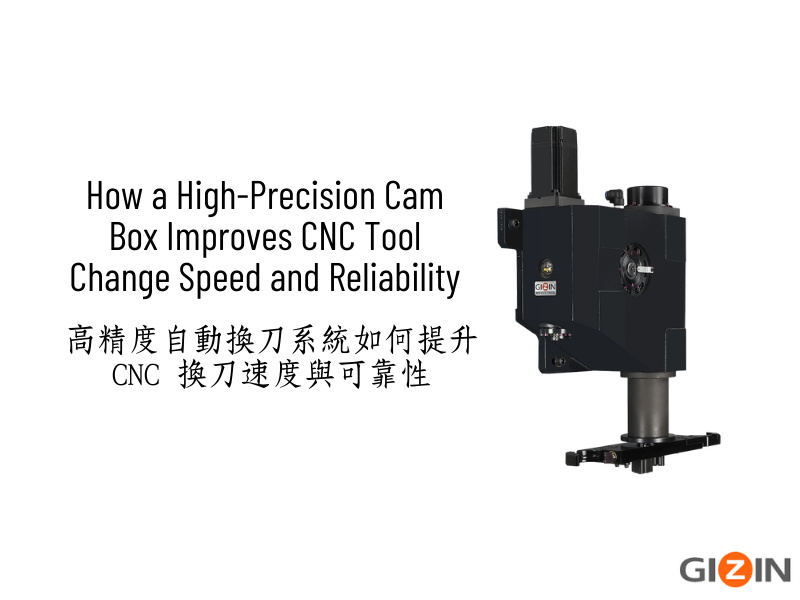
How a High-Precision Cam Box Improves CNC Tool Change Speed and Reliability
In the CNC machine tool industry, the performance of an Automatic Tool Changer (ATC) plays a critical role in determining machining efficiency and production stability. Among the many components involved in the tool change process, the cam box is widely regarded as the core mechanical mechanism that controls the motion of the tool changer arm.
Gizin International, founded in 2001 in Taiwan, specializes in the development and manufacturing of ATC cam boxes and aluminum arms for CNC machine tools. Over the years, the company has focused on designing reliable and high-precision tool changer mechanisms used in CNC machining centers and CNC lathes.
With extensive experience in cam motion engineering and precision manufacturing, the company provides ATC components that support machine tool builders in achieving:
- • Faster and smoother tool change operations
- • Higher reliability in automated machining
- • Long service life for tool changer mechanisms
Its products are widely adopted by machine tool manufacturers in Taiwan and overseas markets, particularly in Japan and other regions where high-performance CNC equipment is required.
Understanding how a high-precision cam box contributes to ATC performance helps illustrate why this component is so important for modern CNC machining.
Understanding the Role of the Cam Box in an ATC System
An Automatic Tool Changer typically consists of several key components working together:
| Component | Function |
|---|---|
| Tool Magazine | Stores multiple cutting tools |
| Tool Changer Arm | Transfers tools between the spindle and the magazine |
| Cam Box | Controls the motion of the tool changer arm |
| Spindle Drawbar | Clamps and releases the tool holder |
| Sensors and Control System | Ensures accurate tool change sequencing |
Within this system, the cam box acts as the motion control core. It converts rotational power from the drive system into coordinated mechanical movements that allow the tool changer arm to perform multiple actions in sequence.
Inside the cam box are precisely engineered cam profiles that synchronize operations such as:
- • Arm extension
- • Tool gripping
- • Arm rotation
- • Tool insertion
Because these actions must occur within fractions of a second and in a highly synchronized order, the precision of the cam box directly determines the overall efficiency of the ATC system.
Faster Tool Change Through Optimized Cam Motion
One of the main advantages of a high-precision cam box is the ability to enable faster tool change cycles.
In many CNC machining centers, the ATC must complete a full tool change within 1–2 seconds. During this short period, the system must remove the current tool from the spindle, retrieve the next tool from the magazine, rotate the arm, and install the new tool.
A carefully designed cam profile ensures that these movements occur smoothly with optimized acceleration and deceleration. Instead of sudden mechanical impacts, the cam motion follows a controlled curve that reduces shock and vibration.
This results in several performance benefits:
- • Shorter tool change time
- • Reduced vibration during arm rotation
- • Lower impact loads on mechanical components
By improving the smoothness of the tool change motion, a high-precision cam box helps maintain both efficiency and mechanical stability.
Improved Reliability in Continuous CNC Operation
CNC machining centers often operate continuously in automated production environments. In such situations, the ATC system may perform thousands of tool changes each day.
If the cam box lacks sufficient precision or durability, problems such as misalignment, unstable motion, or mechanical wear may occur. These issues can lead to tool exchange failures, production interruptions, and increased maintenance requirements.
A high-quality cam box improves system reliability by providing:
- • Accurate synchronization of mechanical movements
- • Stable positioning during tool exchange
- • Consistent arm rotation and insertion accuracy
With these improvements, machine tool builders can achieve more reliable automated machining operations while reducing the risk of unexpected downtime.
Reduced Mechanical Wear and Extended Service Life
Another important benefit of precision cam box design is longer operational lifespan.
Because the cam box controls the motion of the tool changer arm, the shape and accuracy of the cam profile directly affect mechanical stress levels. Poorly designed cam geometry can create excessive friction and impact forces that accelerate wear on components such as bearings, followers, and shafts.
High-precision cam boxes are designed to maintain balanced load distribution throughout the tool change cycle. Combined with high-quality materials and precision machining processes, this helps ensure that the cam surfaces maintain their accuracy even after millions of cycles.
As a result, manufacturers benefit from:
- • Lower component wear
- • Reduced maintenance frequency
- • Longer ATC service life
These advantages are particularly valuable in high-volume production environments where machine uptime is critical.
Supporting High-Performance CNC Manufacturing
As CNC machining technology continues to advance, machine tool builders require ATC systems that can deliver both speed and reliability. High-precision cam boxes play a key role in achieving these goals by ensuring smooth mechanical motion and consistent tool exchange performance.
Through specialized expertise in cam mechanism design and precision manufacturing, companies like Gizin International help support the development of reliable automatic tool changer systems used in modern CNC machines worldwide.
Conclusion
In modern CNC machining centers, efficient and reliable tool changing is essential for maintaining high productivity. The cam box serves as the mechanical heart of the ATC system, controlling the motion of the tool changer arm and coordinating the entire tool exchange sequence.
A high-precision cam box improves CNC performance by enabling faster tool changes, reducing mechanical stress, and ensuring long-term reliability. For machine tool builders seeking stable automation and efficient machining operations, investing in high-quality ATC components is a crucial step toward achieving consistent production performance.