

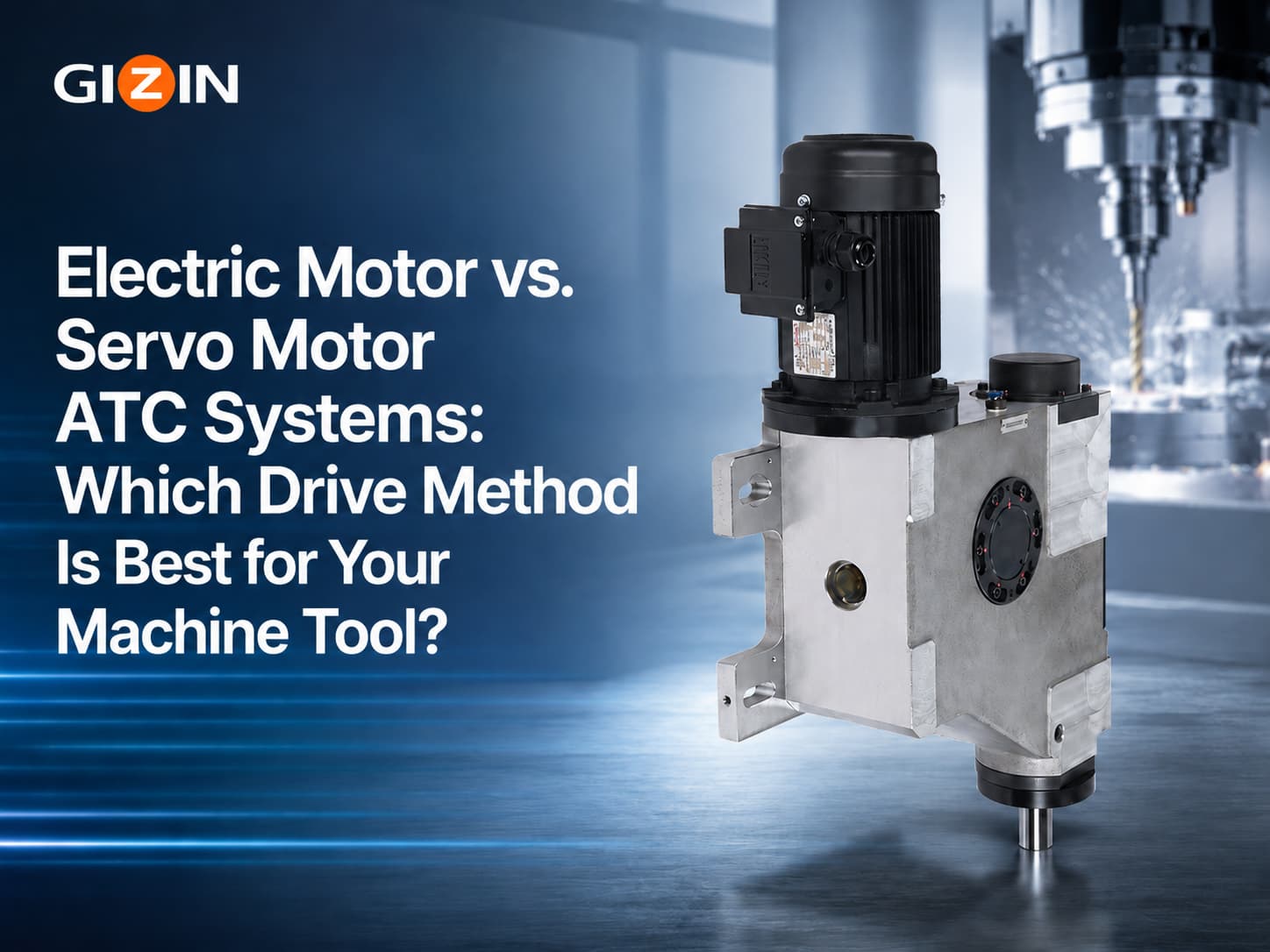
Electric Motor vs. Servo Motor ATC Systems: Which Drive Method Is Best for Your Machine Tool?
In modern CNC machining, productivity is no longer determined solely by spindle speed or cutting performance. The efficiency of the Automatic Tool Changer (ATC) system has become equally important, especially as manufacturers demand shorter cycle times, higher machine utilization, and greater automation.
One key factor that significantly influences ATC performance is the drive system. Today, ATC systems are commonly powered by either conventional electric motors or servo motors. While both solutions can automate tool changes, they differ substantially in terms of positioning accuracy, speed control, flexibility, and overall system performance.
So which drive method is the right choice for your machine tool?
The answer depends not only on the motor itself, but also on how effectively the drive system works together with the ATC cam box mechanism.
Understanding the Role of the ATC Drive System
The drive system provides the motion required to operate various components within an ATC system, including:
- • Tool magazines
- • Tool changer arms
- • Cam box mechanisms
- • Tool indexing systems
- • Tool positioning movements
The drive system directly affects:
- • Tool change speed
- • Positioning accuracy
- • Motion smoothness
- • Reliability
- • Maintenance requirements
Selecting the appropriate drive method is therefore a critical part of ATC system design.
What Is a Motor-Driven ATC System?
A motor-driven ATC system uses a standard electric motor to drive the tool changer mechanism.
These systems typically rely on:
- • AC motors
- • Induction motors
- • Mechanical indexing devices
- • Cam-controlled motion systems
Because the movement path is mechanically defined, the system offers stable and repeatable operation with relatively simple control architecture.
Advantages of Motor-Driven ATC Systems
- • Lower initial investment cost
- • Simple electrical control
- • Proven and reliable technology
- • Easy maintenance
- • Suitable for standard machining centers
For many BT30 and BT40 machining centers, motor-driven ATC systems continue to provide excellent performance and reliability.
Limitations of Motor-Driven ATC Systems
However, conventional motors also have certain limitations:
- • Limited positioning flexibility
- • Fixed motion profiles
- • Less control over acceleration and deceleration
- • Difficult to optimize for complex tool-changing sequences
As machine tools become faster and more sophisticated, these limitations may become more noticeable.
What Is a Servo-Driven ATC System?
A servo-driven ATC system uses a servo motor equipped with encoder feedback to control movement precisely.
Unlike conventional motors, servo systems continuously monitor position and speed, allowing the controller to make real-time adjustments.
This enables:
- • Precise positioning
- • Flexible motion programming
- • Smooth acceleration and deceleration
- • Higher-speed operation
Servo technology has become increasingly common in advanced CNC machining centers and large-capacity tool magazine systems.
Advantages of Servo-Driven ATC Systems
Higher Positioning Accuracy
Servo motors provide closed-loop control, ensuring highly accurate positioning during every tool change cycle.
This is especially valuable for:
- • Large tool magazines
- • Multi-axis machines
- • High-speed machining centers
Faster Tool Changes
Because acceleration and deceleration can be optimized, servo-driven systems often achieve faster cycle times while maintaining smooth operation.
Greater Flexibility
Motion profiles can be adjusted through software rather than mechanical modifications.
Machine builders can optimize performance for:
- • Different tool capacities
- • Various machine sizes
- • Specialized applications
Better Monitoring Capabilities
Servo systems provide feedback data that can be used for:
- • Diagnostics
- • Predictive maintenance
- • Performance monitoring
Motor-Driven vs. Servo-Driven ATC Systems
| Feature | Motor-Driven ATC | Servo-Driven ATC |
|---|---|---|
| Initial Cost | Lower | Higher |
| Control Complexity | Simple | Advanced |
| Positioning Accuracy | Good | Excellent |
| Speed Optimization | Limited | Highly Flexible |
| Motion Control | Fixed | Programmable |
| Diagnostic Capability | Basic | Advanced |
| Large Tool Magazine Support | Moderate | Excellent |
| High-Speed CNC Machines | Suitable | Ideal |
Which ATC Drive System Is Right for Your Machine?
The answer depends on your application requirements.
Motor-Driven ATC Systems Are Ideal For:
- • Standard vertical machining centers
- • Cost-sensitive projects
- • Medium-speed machining operations
- • Proven, straightforward machine designs
These systems continue to deliver reliable performance in many production environments.
Servo-Driven ATC Systems Are Ideal For:
- • High-speed machining centers
- • Large-capacity tool magazines
- • Multi-axis CNC machines
- • Advanced automation systems
- • Applications requiring maximum productivity
As manufacturing demands continue to increase, many machine builders are adopting servo-driven solutions to achieve greater flexibility and performance.
Why the ATC Cam Box Matters Regardless of the Drive Method
While the drive motor receives significant attention, the performance of the ATC cam box remains equally critical.
Whether an ATC system is powered by a conventional motor or a servo motor, the cam box is responsible for converting rotational input into synchronized mechanical motion.
A high-quality ATC cam box helps ensure:
- • Smooth tool-changing movements
- • Accurate timing synchronization
- • Reduced vibration and impact loads
- • Improved reliability
- • Longer service life
In many cases, the overall performance of an ATC system depends not only on the motor selected but also on the quality and design of the cam box mechanism.
How GIZIN Supports Modern ATC Systems
At GIZIN, we specialize in developing high-performance ATC cam box solutions for both motor-driven and servo-driven ATC systems.
Our engineering team works closely with machine tool builders to provide:
- • Customized ATC cam box designs
- • Stable and precise motion control
- • High-speed tool-changing performance
- • Long-term durability and reliability
- • Integration support for various CNC machine configurations
Whether your machine utilizes a conventional motor or advanced servo technology, GIZIN's ATC solutions are designed to maximize tool-changing performance and machine productivity.
Conclusion
Both motor-driven and servo-driven ATC systems have their advantages. Motor-driven systems offer simplicity, reliability, and cost efficiency, while servo-driven systems provide greater flexibility, precision, and speed.
The best choice depends on your machine design, production goals, and application requirements.
However, regardless of the drive method selected, the performance of the ATC cam box remains a key factor in achieving smooth, reliable, and efficient tool changes.
By combining the right drive technology with a precision-engineered ATC cam box, machine builders can maximize productivity, improve reliability, and create long-term value for their customers.
Looking for the right ATC solution for your machine tool?
GIZIN provides precision-engineered ATC cam box systems designed to support both motor-driven and servo-driven automatic tool changers. Contact us today to discuss your application requirements and discover how we can help optimize your machine performance.