

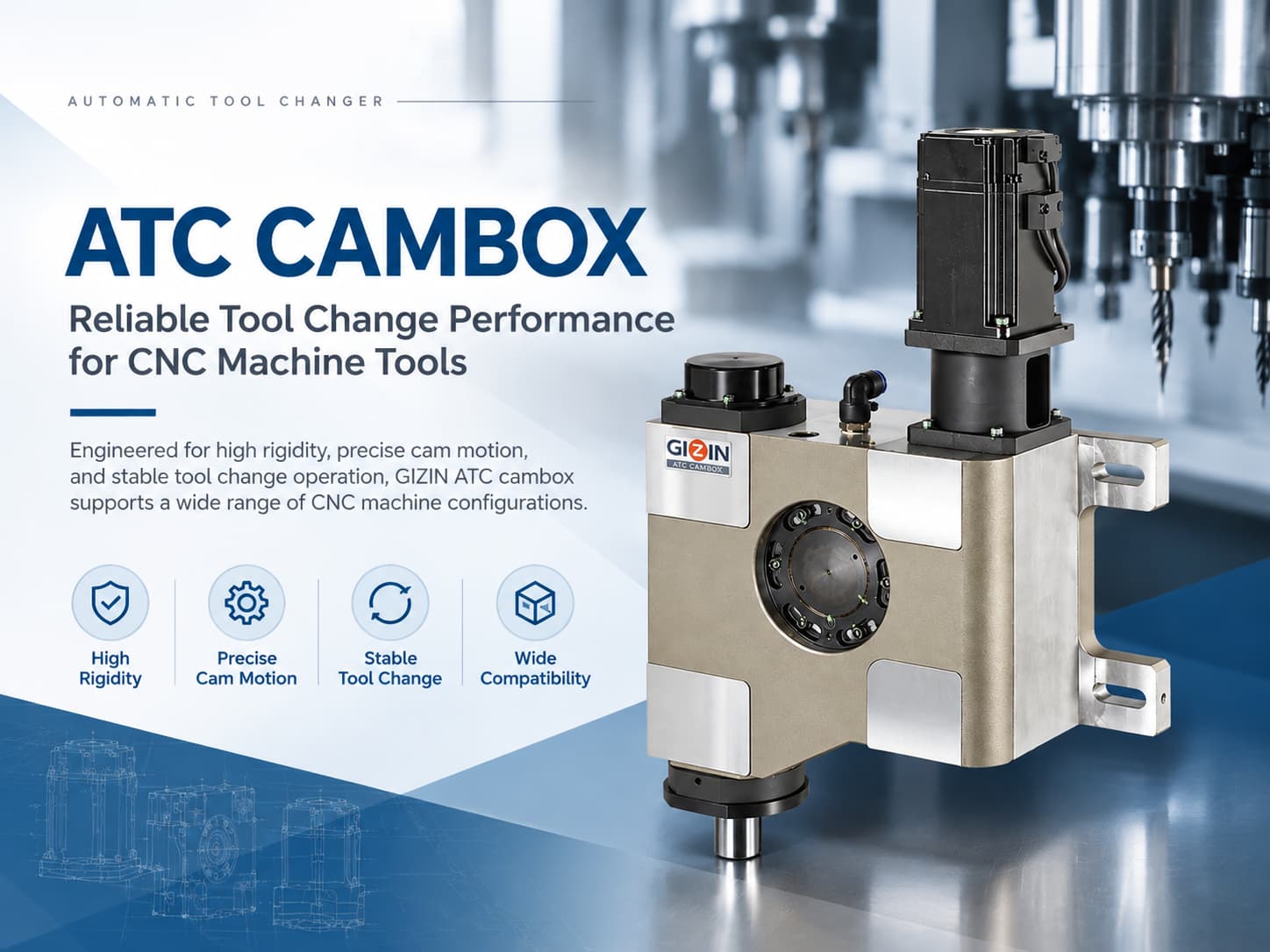
Selecting an automatic tool changer (ATC) for a new CNC machine involves more than choosing a spindle taper and comparing prices. For machine tool builders, the accuracy of an ATC quotation depends on how clearly the machine's technical requirements are communicated.
Before requesting an ATC Cambox quotation, manufacturers should prepare the machine type, spindle taper, tool holder specifications, maximum tool weight, ATC arm dimensions, installation requirements, target tool change time, and drive and feedback preferences.
Providing these details early helps the ATC supplier identify a suitable product configuration, clarify compatibility questions, and determine whether a standard model or a customized solution should be evaluated. GIZIN offers ATC Cambox products for different machine configurations and an online product inquiry form for initial discussions.
1. What Information Should You Prepare Before Requesting an ATC Quotation?
A useful quotation request should describe not only the ATC component, but also the machine in which it will operate. The following checklist provides a practical starting point.
| Information | What to Provide | Why It Matters |
|---|---|---|
| Machine type | Vertical, horizontal, or other CNC configuration | Determines the general ATC arrangement |
| Spindle taper | #30, #40, #50, or applicable specification | Narrows the suitable product range |
| Tool holder standard | BT, HSK, or another applicable standard | Helps confirm tool gripping and exchange compatibility |
| Maximum tool weight | Weight per tool, including the holder | Supports load-capacity evaluation |
| Tool dimensions | Maximum diameter, length, and clearance | Helps evaluate the exchange envelope |
| ATC arm dimensions | Required arm radius, travel, and swing angle | Helps match exchange geometry |
| Target tool change time | Cycle time and measurement definition | Establishes the performance target |
| Drive and feedback | Motor, sensor, encoder, or servo requirements | Supports machine control integration |
| Installation information | Mounting dimensions, positions, available space | Identifies interface and clearance constraints |
Not every project requires the same level of detail during the first inquiry. However, clearly defined requirements make it easier to evaluate the application without unnecessary assumptions.
2. Start With the CNC Machine Type and Spindle Configuration
One of the first questions an ATC manufacturer needs to answer is: What type of CNC machine will use the ATC? A vertical machining center and a horizontal machining center may require different tool exchange arrangements, mounting orientations, and arm configurations.
Confirm the Spindle Taper and Tool Holder Standard
The spindle taper helps narrow the initial ATC selection, but it does not confirm compatibility on its own. Two machines with the same nominal taper may use different holder interfaces, magazine layouts, or exchange requirements.
- ● Spindle taper and machine orientation
- ● Tool holder standard and relevant interface dimensions
- ● Spindle and magazine tool exchange positions
- ● Any special tool holder or gripping requirements
GIZIN's ATC Cambox range includes #30, #40, and #50 categories, with vertical and horizontal configurations for different machine tool applications.
3. Define the Maximum Tool Weight and Tool Dimensions
Tool weight is important, but the relevant load generally includes the tool holder and complete assembly handled during tool change.
- ● Maximum weight of each complete tool assembly
- ● Maximum tool diameter and length
- ● Tool holder dimensions
- ● Expected tool center of gravity, particularly for long or heavy tools
- ● Any unusual or unbalanced tooling configurations
Why Does Tool Size Matter as Much as Tool Weight?
Two tools of equal weight may behave differently if their lengths and centers of gravity differ. Long tools can create additional clearance and loading considerations even within stated weight capacity. An ATC quotation should not be based on maximum weight alone.
4. Provide ATC Arm Dimensions and Installation Requirements
A suitable ATC Cambox must match the machine's tool exchange geometry. Provide known arm radius, travel, swing angle, and layout dimensions.
- ● Distance between spindle and magazine exchange positions
- ● Required ATC arm radius
- ● Tool extraction and insertion travel
- ● Required swing angle
- ● Available mounting space
- ● Clearance for moving tools and the ATC arm
What if the Machine Design Is Not Finalized?
An initial technical discussion can still begin. Identify fixed dimensions and those that remain adjustable. For example, the spindle location may be final while magazine position or ATC mounting remains under development.
5. Clarify the Required Tool Change Time
"We need a fast ATC" does not define what the timing target measures.
ATC cycle time refers to the defined mechanism cycle under specified conditions; machine tool-to-tool time may include spindle positioning, orientation, magazine preparation, clamping, and control confirmation.
Agree on measurement boundaries when comparing specifications.
- ● Target ATC cycle time, if defined
- ● Target machine tool-to-tool time
- ● Expected tool weight during measurement
- ● Intended operating frequency
- ● Machine sequence constraints affecting performance
6. Specify the Drive System and Position Feedback Requirements
An ATC Cambox operates within a larger machine control system. Motor and position feedback requirements should be discussed before finalizing the configuration.
- ● Preferred motor or drive arrangement
- ● Electrical supply requirements
- ● Sensor or encoder requirements
- ● Servo-related integration requirements, where applicable
- ● Required position confirmation signals
- ● CNC or PLC interface considerations
Options vary by product. The supplier should confirm available configurations rather than assume that all drive and feedback options can be freely combined.
7. Should You Request a Standard or Customized ATC Cambox?
Not every CNC machine requires a completely new ATC design. A standard platform may be suitable, while certain layouts or exchange requirements need further engineering evaluation.
- ● Unusual spindle or magazine arrangement
- ● Restricted installation envelope
- ● Special arm dimensions
- ● Specific drive or feedback requirements
- ● Nonstandard tool exchange geometry
The supplier can evaluate whether an existing model, available configuration, or customized solution is appropriate. GIZIN describes modular configurations and customized ATC capabilities; feasibility must be confirmed for each project.
8. Common Mistakes That Delay an ATC Quotation
| Incomplete Inquiry | More Useful Information |
|---|---|
| "We need a #40 ATC." | #40 taper, machine orientation, holder standard, exchange arrangement |
| "The ATC must be very fast." | Target cycle time, measurement definition, operating load |
| "Our tools are heavy." | Complete assembly weight, length, diameter |
| "We need a compact design." | Mounting envelope and layout drawings |
| "We want servo control." | Drive functions, feedback signals, machine control requirements |
The goal is not an unnecessarily complicated specification package; it is enough information to evaluate possible configurations and avoid misunderstandings.
9. A Practical ATC Quotation Checklist for Machine Builders
- CNC machine type and application
- Spindle taper and tool holder standard
- Maximum complete tool weight and dimensions
- ATC arm radius, travel, and swing angle
- Spindle and magazine exchange positions
- Installation envelope or layout drawing
- Target ATC cycle time and tool-to-tool time
- Motor, sensor, encoder, or servo requirements
- Expected order quantity and project schedule
- Any special or customized requirements
Not every item must be finalized before the first inquiry. Clearly mark preliminary specifications. Order quantity and schedule are general B2B procurement considerations, not necessarily mandatory fields on GIZIN's inquiry form.
10. Requesting an ATC Cambox Quotation From GIZIN
GIZIN specializes in ATC systems and ATC Cambox products for CNC machine tool manufacturers. Its range includes vertical and horizontal configurations.
Its product inquiry form offers a starting point for communicating ATC category, tool holder type, arm radius, swing angle, tool weight, speed, and drive or sensor preferences.
If your company is developing a new CNC machine or evaluating an ATC Cambox for an existing platform, prepare the available specifications and discuss product suitability with GIZIN.
Planning an ATC Cambox Project?
Share your machine specifications, tool requirements, installation dimensions, and target tool change time with GIZIN to begin a product suitability discussion.
Frequently Asked Questions
Can I request an ATC quotation before my CNC machine design is complete?
Initial discussions can use preliminary specifications if confirmed and adjustable requirements are clearly identified.
Is spindle taper enough to select an ATC Cambox?
No. Holder standard, orientation, tool weight, arm geometry, and installation requirements also affect compatibility.
Do I need to provide a machine layout drawing?
It is particularly useful for exchange positions, mounting, and clearance, especially in compact or nonstandard designs.
Should I specify both ATC cycle time and tool-to-tool time?
Yes, if available. They can measure different portions of the sequence, so defining both helps prevent misleading comparisons.
Can GIZIN evaluate customized ATC requirements?
GIZIN lists customized ATC capabilities. Feasibility depends on the specific technical requirements and machine configuration.
Conclusion
An accurate ATC Cambox quotation begins with clear technical communication. Machine builders should prepare the machine configuration, tool holder specifications, tool weight and dimensions, arm geometry, installation requirements, target cycle time, and control preferences.
Providing this information helps both parties evaluate the application efficiently and reduces the risk of choosing a mismatched configuration.
The better the initial specifications, the more productive the ATC quotation and engineering discussion can be.