

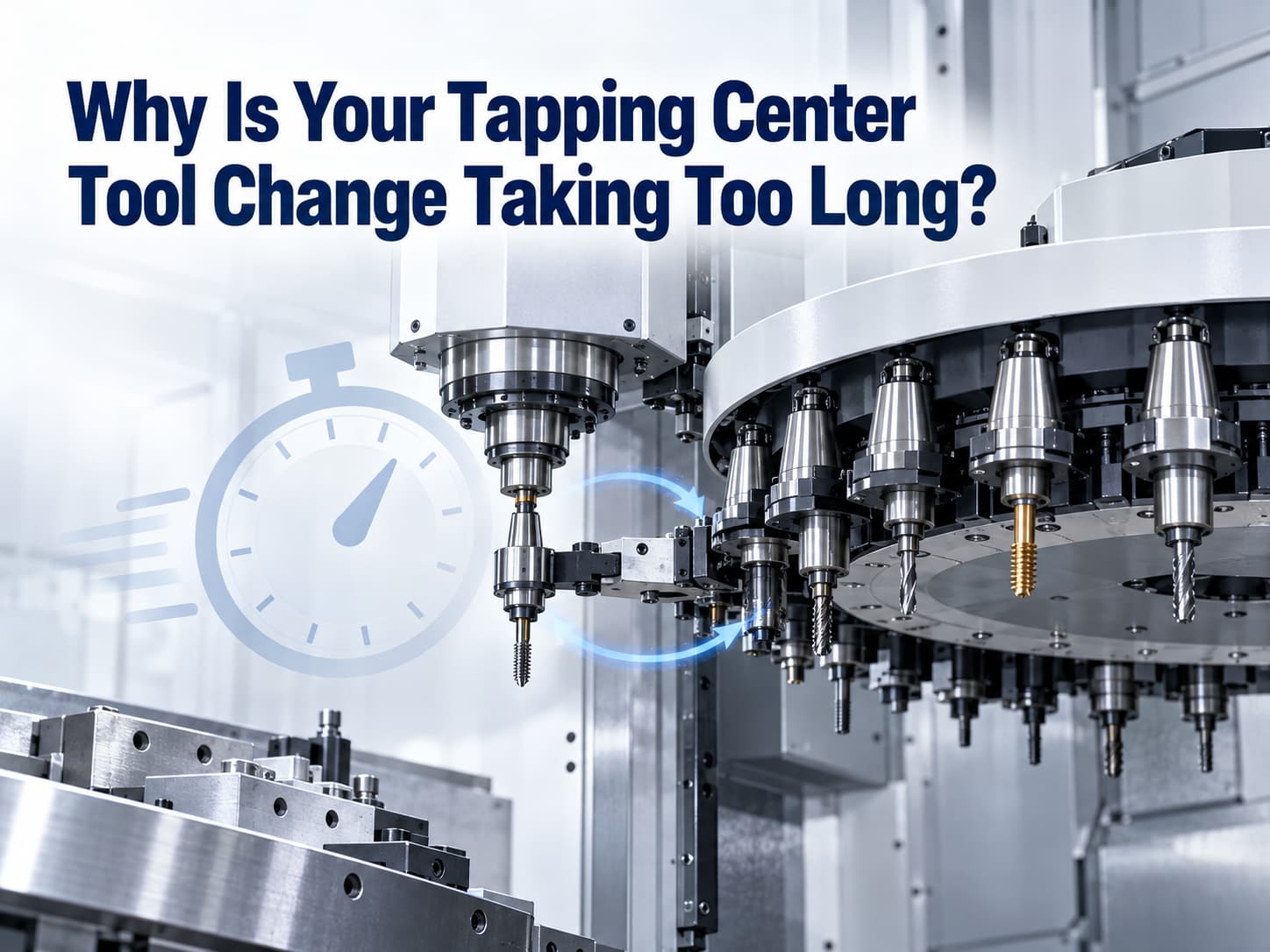
Why Is Your Tapping Center Tool Change Taking Too Long?
Tapping centers are designed for fast, repetitive machining. When drilling, tapping, milling, and other short-cycle operations are performed on the same workpiece, even a small delay between tools can accumulate into significant production time.
This is why machine builders may encounter an important question: if the cutting process is already fast, why is the total machining cycle still longer than expected?
The answer may not be the cutting process itself. The complete tool change sequence—including spindle preparation, magazine positioning, ATC arm movement, tool exchange, and position confirmation—can become a bottleneck.
For machine builders developing high-speed tapping centers, reducing tool change time therefore requires looking at the entire tool-changing system rather than simply selecting an ATC with the shortest published cycle time.
Why Tool Change Time Matters More on a Tapping Center
Tool change time affects every machining center, but its impact becomes especially noticeable when individual machining operations are short.
Consider a workpiece that requires several operations:
- Drilling
- Tapping
- Chamfering
- Milling
- Finishing
The machine may spend only a short time performing each operation before requesting the next tool.
If several tool changes are required for every part, an additional fraction of a second at each change is repeated across every workpiece and every production cycle.
This means the real question is not simply:
How fast is the ATC?
It is:
How efficiently can the complete tapping center move from one machining operation to the next?
1. Is the ATC Really the Cause of the Slow Tool Change?
Before changing the ATC specification, machine builders should first identify where the time is actually being spent.
A complete automatic tool change may involve several actions:
- The machining operation finishes.
- The spindle moves to the tool change position.
- The spindle decelerates and orients.
- The magazine prepares the next tool.
- The tool is unclamped.
- The ATC arm grips and exchanges the tools.
- The new tool is clamped.
- The ATC returns to its home position.
- The machine confirms that the next operation can begin.
The ATC arm movement is therefore only one part of the total sequence.
A fast ATC cannot fully compensate for delays elsewhere in the machine. Machine builders should separate ATC cycle time from the machine's total tool-to-tool time before deciding which component needs to be optimized.
2. Check the ATC Arm Travel and Motion
For a tapping center, unnecessary movement can add time to every tool change.
The ATC arm needs enough travel to safely remove and insert the tool, but excessive travel may create a longer motion path than the application requires.
Machine builders should evaluate:
- Spindle-to-ATC position
- Required arm travel
- Arm length
- Tool extraction distance
- Rotation angle
- Magazine exchange position
The goal is not simply to shorten the arm or travel as much as possible. These dimensions must still provide adequate clearance and reliable tool engagement.
A well-matched ATC configuration can reduce unnecessary movement while maintaining stable tool exchange.
3. Does the ATC Match the Tool Requirements?
Tapping centers commonly use relatively compact tool configurations, but machine specifications still vary.
Before selecting an ATC, the machine builder should confirm:
- Spindle taper
- Maximum tool diameter
- Maximum tool length
- Maximum tool weight
- Tool holder configuration
- Tool center of gravity
An ATC designed for much heavier tools than the application requires may not provide the best balance for a compact, high-speed machine.
Conversely, selecting an ATC only because it offers a short cycle time without checking the actual tool requirements may create reliability or compatibility problems.
The objective should be to match the ATC's load capacity and motion characteristics to the tools the tapping center will actually use.
For a more detailed explanation of how tool specifications influence automatic tool changing, read How Tool Weight, Length, and Balance Affect ATC Tool Change Safety.
4. Is the Drive and Cam Motion Suitable for Frequent Tool Changes?
A tapping center may perform a large number of tool changes during continuous production. This means the ATC must deliver not only fast motion, but also repeatable motion over frequent cycles.
The ATC cam mechanism plays an important role because it controls the timing and movement of the tool-changing sequence.
Acceleration, rotation, deceleration, gripping, and positioning need to work together smoothly. Simply increasing motor speed does not automatically create a better tool change.
The drive system must also match the required motion control. Depending on the machine design, different motor, sensor, encoder, or servo configurations may be considered.
For high-frequency applications, repeatability and motion stability are just as important as the fastest single-cycle specification.
To better understand the relationship between cam accuracy, tool change speed, and repeatability, see How a High-Precision Cam Box Improves CNC Tool Change Speed and Reliability.
5. Look at the Magazine and Spindle, Not Just the ATC
A machine builder may install a fast ATC and still find that the overall tool change takes too long.
One reason is that the ATC has to work together with the spindle and tool magazine.
For example, total cycle time may be affected by:
- Spindle orientation time
- Spindle movement to the tool change position
- Tool unclamping and clamping
- Magazine indexing
- Tool pot positioning
- Sensor confirmation
- CNC sequence timing
If the ATC is ready but the spindle or magazine is not, the next movement still has to wait.
This is why optimizing a tapping center requires reviewing the entire tool change sequence as one synchronized system.
6. Faster Is Not Always Better
It can be tempting to compare ATCs only by the shortest cycle time listed in a specification sheet.
However, the fastest specification does not automatically mean the fastest production machine.
Tool change performance should be evaluated together with:
- Tool weight
- Arm length and travel
- Machine layout
- Structural rigidity
- Spindle interface
- Magazine response
- Drive configuration
- Required reliability
Increasing speed without considering these conditions may increase vibration or mechanical load.
For a tapping center intended for continuous production, a fast and repeatable tool change is more valuable than achieving an aggressive cycle time that does not match the actual machine configuration.
The ATC drive system can also influence motion control and machine integration. Machine builders comparing different drive configurations can read Electric Motor vs. Servo Motor ATC Systems: Which Drive Method Is Best for Your Machine Tool?.
7. Choosing an ATC for a High-Speed Tapping Center
When developing a tapping center, machine builders should define the required tool change performance early in the design process.
Important information to prepare includes:
- Spindle taper
- Tool holder standard
- Spindle and magazine positions
- Maximum tool size and weight
- Required arm travel
- Available installation space
- Target ATC cycle time
- Target machine tool-to-tool time
- Drive and feedback requirements
These specifications make it easier to determine whether an existing ATC platform already matches the application or whether certain dimensions and configurations should be adjusted.
If installation space is also a key constraint in your machine design, see Designing an ATC for Limited Installation Space: Key Factors for Machine Tool Builders.
A GIZIN ATC Option for #30 Taper Machines
For compact vertical machines using a #30 taper, GIZIN's GE-30 C20 Vertical Automatic Tool Changer is one platform that machine builders can evaluate.
According to GIZIN's published specifications, the GE-30 C20 is designed for #30 taper vertical machines and provides a configuration suitable for compact, high-speed machine applications.
| Specification | GE-30 C20 |
|---|---|
| Application | #30 Taper Vertical Machines |
| Arm Travel | 85 mm |
| Arm Length (Radius) | 150–250 mm |
| Max. Tool Weight | 1–4 kg × 2 |
| Cycle Time | 0.6–2 sec |
| Swivel Angle | 60°–90° |
| Drive Motor | 0.75 kW |
| Sensor | Encoder / Servo |
| Lubrication | Oil Bath |
These specifications should not be considered in isolation. The appropriate ATC still depends on the tapping center's spindle, magazine, tool specifications, machine layout, and target cycle time.
The objective is not simply to install the fastest ATC available, but to select and configure a tool-changing system that matches the machine.
Conclusion
When a tapping center's tool change takes longer than expected, the ATC may be part of the problem—but it is not necessarily the only cause.
Machine builders should examine the complete sequence from spindle positioning and magazine preparation to ATC arm motion, tool clamping, and position confirmation.
For high-speed tapping centers, the best tool-changing solution balances short cycle time, compact motion, appropriate tool capacity, repeatability, and long-term reliability.
GIZIN provides automatic tool changer platforms for CNC machine tools, including #30 vertical configurations that can be evaluated according to different machine requirements.
Frequently Asked Questions
Why is my tapping center's total tool change time longer than the ATC cycle time?
Because the published ATC cycle time generally represents the ATC mechanism itself. The machine's total tool-to-tool time can also include spindle positioning and orientation, magazine indexing, unclamping/clamping, sensor confirmation, and CNC sequence timing.
Should I always choose the ATC with the shortest cycle time?
No. Cycle time should be evaluated together with tool specifications, arm travel, machine layout, spindle interface, structural requirements, and expected operating frequency.
Can arm travel affect tool change time?
Yes. Arm travel affects the movement required during tool exchange. However, it cannot simply be shortened; sufficient travel and clearance are required for reliable tool removal and insertion.
What information should a machine builder provide when selecting an ATC for a tapping center?
At minimum, provide the spindle taper, tool holder standard, maximum tool size and weight, spindle and magazine positions, required arm travel, available installation space, and target tool change time.